1926
The College of Commerce and Finance was established in downtown Los Angeles. The first business courses included “Introduction to Economics” and “Constructive Accounting.”
1929: Loyola University relocates to Westchester
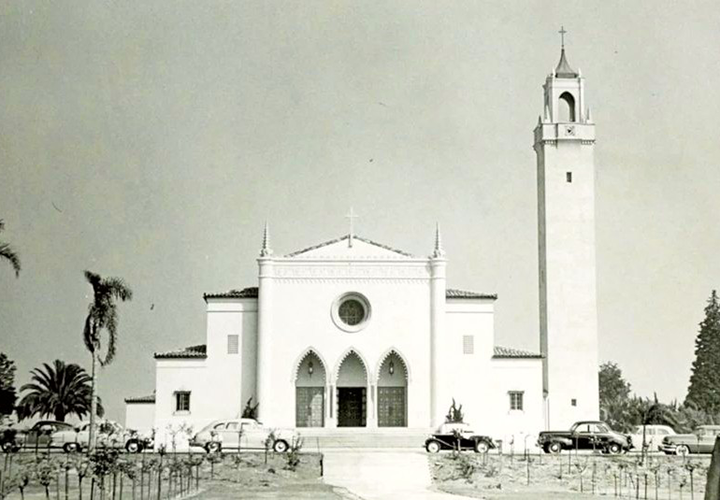
After relocating from downtown L.A. to Westchester, the first business classes were held in Foley, St. Robert’s Hall, and military huts. A B.S. in Commerce was the first degree offered, and the first graduating class had 13 students.
1933
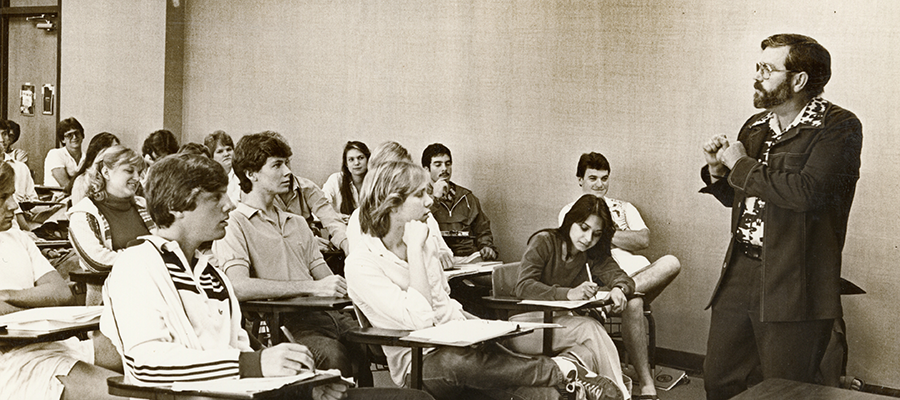
Name simplified to College of Commerce; students could major in either Accounting or General Business. There were only three full-time faculty members at the time, with plans in place for additional hires.
1935
Renamed the College of Business Administration. This broad title allowed for new disciplines to emerge and grow.
1944: Enrollment drops to 7 students due to World War II
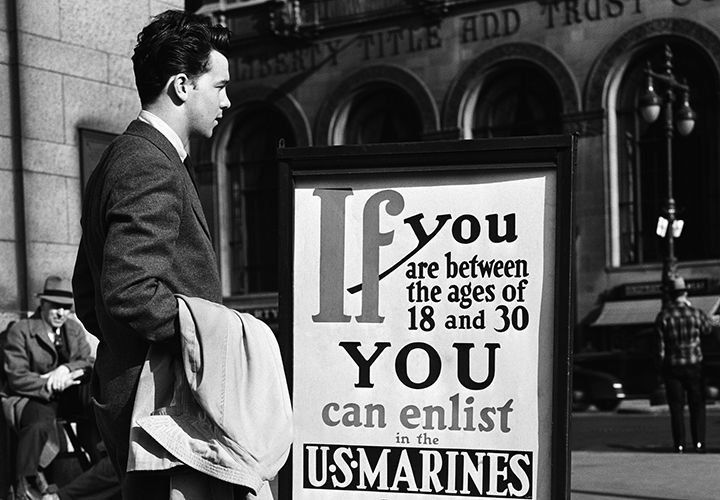
Recruitment efforts by the U.S. military led to a significant decline in enrollment during the onset of World War II, placing the entire university in economic jeopardy. Most of the faculty were on leave as well.
1946
The Industrial Relations major was introduced; enrollment increased to 180 students.
1948: Enrollment skyrockets to 681 students due to GI Bill
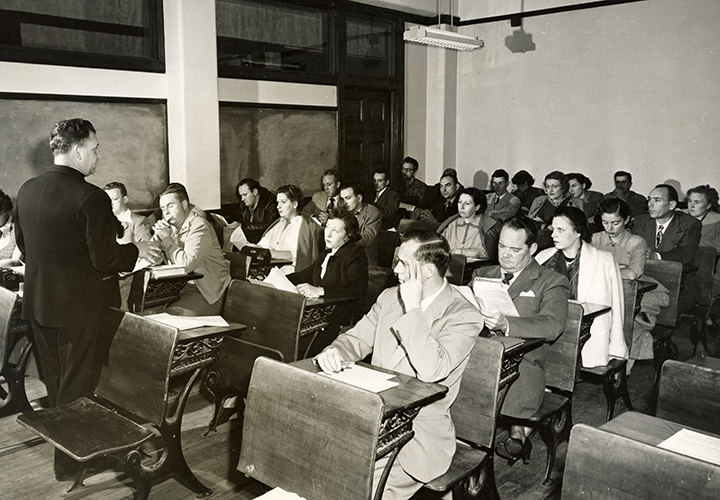
The educational benefit package for veterans, the GI Bill, helped put Loyola University back on solid financial footing. The College of Business Administration contributed significantly to the university's economic recovery. The finance curriculum was also introduced this year.
1952
Departments of Accounting, Finance, and General Business were established. There were now 10 full-time faculty in the college.
1969: B.S. in Accounting degree established
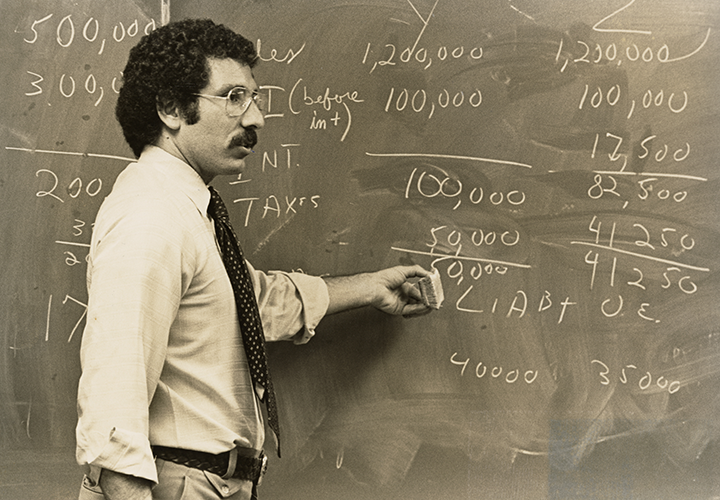
Accounting was one of the most popular professions in the 1960s and most deans at the time had a background in accounting. The already well-regarded Loyola Accounting program was expected to gain greater stature with the major accounting firms, known then as the Big 8.
1972: Entrepreneurship Program established
LMU was one of the first universities in the U.S. to offer an entrepreneurship program. The LMU Entrepreneurship Program is consistently ranked by U.S. News & World Report, Princeton Review, and Entrepreneur, and has grown to become one of the most popular majors on campus.
1973: Loyola University and Marymount College merge
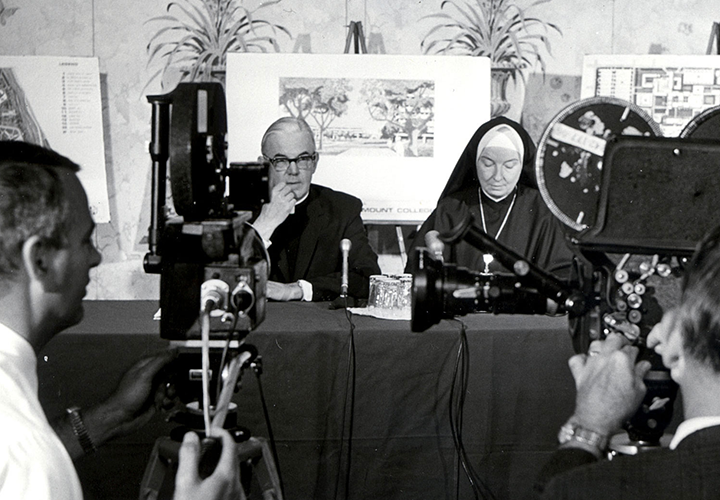
Loyola University and Marymount College merged to become Loyola Marymount University. The merger added women to what had been an all-male school. The universities complemented each other, with Loyola offering business, engineering, and graduate programs while Marymount focused on the arts and humanities.
1974: MBA Program launches
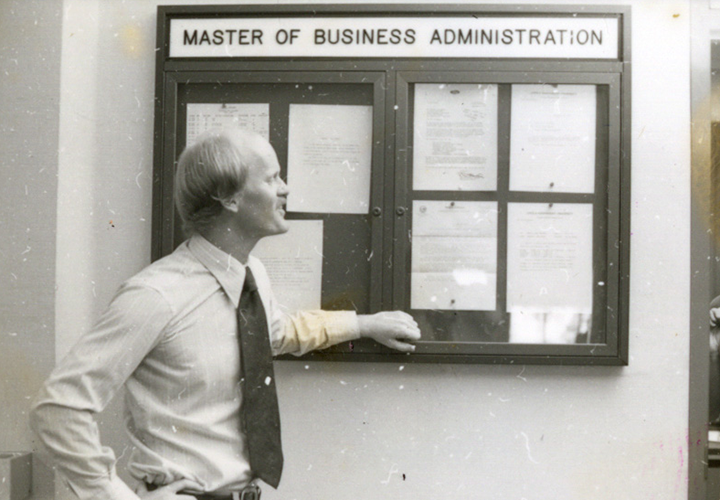
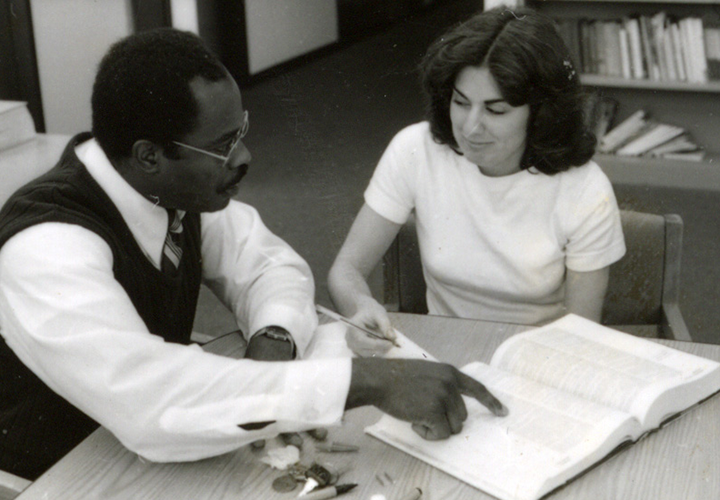
At the time, the aerospace industry was the largest employer in Los Angeles, and engineers could benefit from having an MBA degree. Julius Brown was appointed the first director of the MBA Program.
1978
The Business Advisory Council was established by Dean Williamson. Business leaders included Ken Olsen, CEO of Vons; Jim Kilroy, CEO of Kilroy Industries; Thomas Grojean, CEO of Flying Tigers; and Guy Wilson, Managing Partner of Ernst & Whinney.
1981: Undergraduate program accredited by AACSB
CBA is a proud member of AACSB International - the Association to Advance Collegiate Schools of Business. Less than 5% of the world's 16,000 business programs have earned AACSB accreditation.
1982
The Beta Gamma Sigma chapter at LMU was established. Beta Gamma Sigma is the international honor society serving business programs accredited by AACSB International. The top 10% of undergraduate students and top 20% of graduate students are invited to become lifetime members.
1987: MBA Program accredited by AACSB
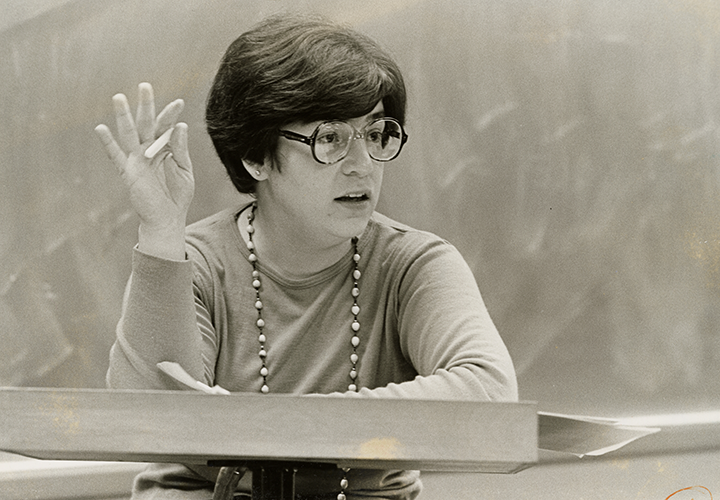
The MBA Program received AACSB accreditation after making progress in hiring qualified faculty, increasing the scholarly productivity of the faculty, establishing a computer lab, and enhancing its focus on business ethics. Rachelle Katz (pictured) served as director of the program from 1994-2011.
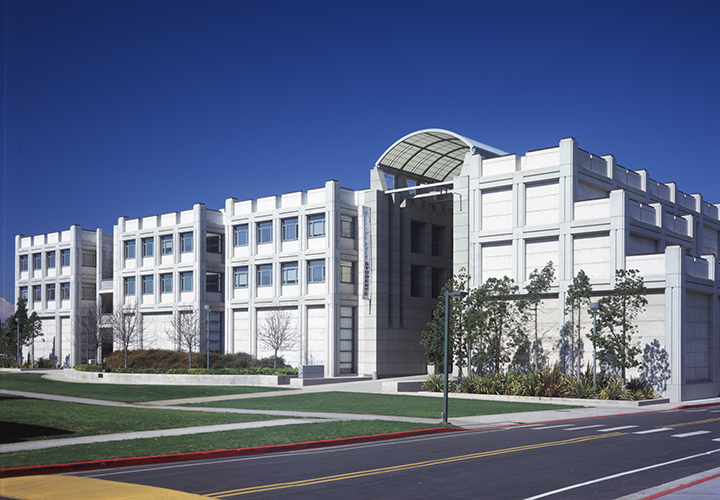
1995: Conrad N. Hilton Center for Business opens
Doors opened on August 28 with an official dedication on October 27. The International Association for Jesuit Business Schools (IAJBS) was founded the same year by John Wholihan, a former dean of the CBA, who served as the association’s first president.
1999
The Hilton Chair in Entrepreneurship was established with Fred Kiesner as the inaugural chair. David Choi, professor of entrepreneurship, currently holds the chair.
2000
The Executive MBA Program was founded by Bill Lindsey, appealing to upper- and mid-level managers seeking to advance their knowledge and skills.
2004: R. Chad Dreier Chair in Accounting Ethics established
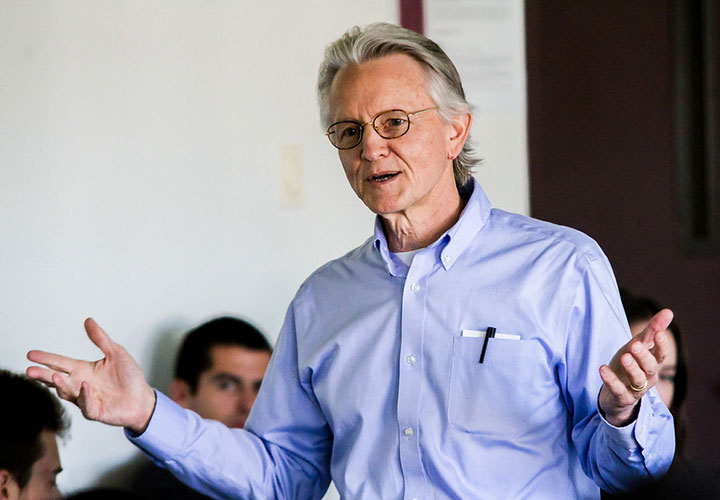
Named after LMU accounting alumnus R. Chad Dreier ’69, the R. Chad Dreier Chair in Accounting Ethics, currently held by Professor Larry Kalbers (pictured), enabled the Department of Accounting to develop an accounting ethics course a decade before such a course was required by the California State Board of Accountancy for CPA licensure. The Student Investment Fund also started this year.
2005: Paul A. Grosch Professorship established
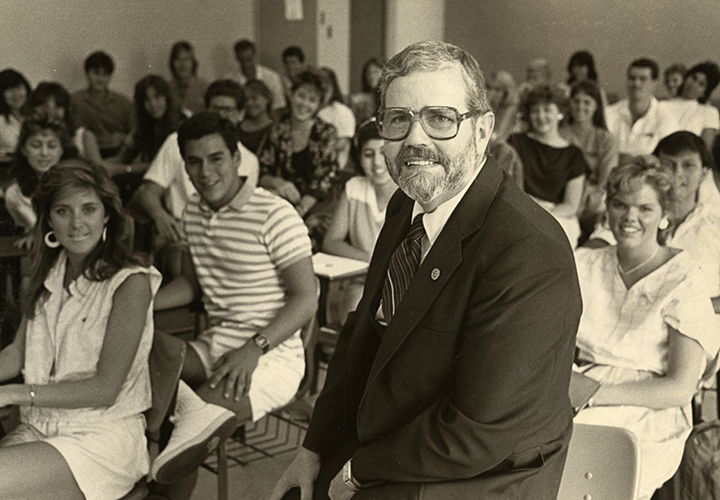
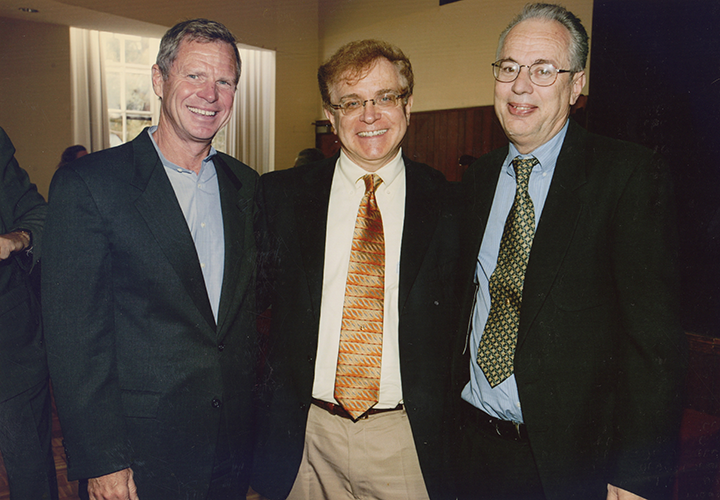
Paul A. Grosch was a professor of accounting from 1952 to 1984. In 2002, a group of his former students established the Paul A. Grosch Professorship with a $1 million endowment. Its first holder was Professor George Dasaro (pictured at far right).
2009
The Fred Kiesner Center for Entrepreneurship was established with a $5 million endowment. Named after "Grampa Fred” who built the LMU Entrepreneurship Program from the ground up, the center offers numerous experiential and co-curricular activities designed to engage and enhance students' entrepreneurial competence.
2012: M-School established
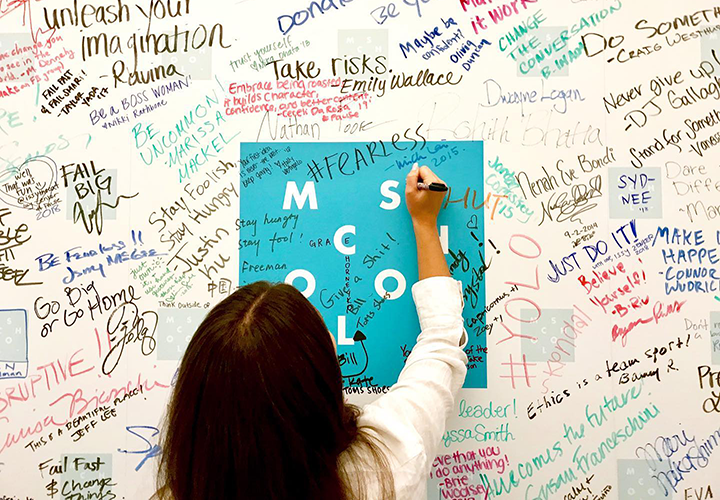
The M-School is a popular marketing pathway that was born from the need to transform the way our students learn about and are immersed in the new world of advertising and branding. The innovative and cutting-edge curriculum and access to local ad agencies set this program apart.
2013
The M.S. in Accounting program was introduced to comply with the 150-hour California requirement for CPA licensure.
2017
The Institute for Business Ethics and Sustainability (IBES) was established with a mission to engage individuals and organizations in corporate ethical, social, and environmental responsibility for the 21st century.
2018: The college named a UN PRME signatory
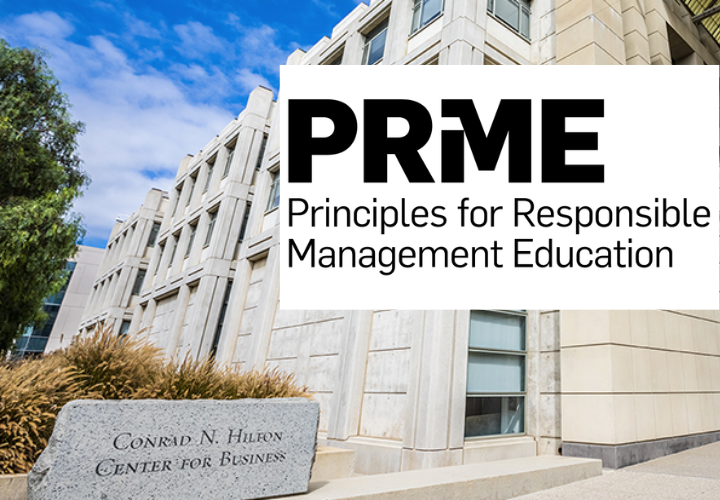
Dean Dayle Smith began her tenure in 2018. One of her first accomplishments was getting the college named as a UN PRME signatory, a designation for institutions that advance responsible management education through initiatives, partnerships, and SDG commitments.
2019
The college continued to expand its graduate program portfolio with the launch of the M.S. in Management and M.S. in Business Analytics programs. One-year master's programs surged in popularity.
2020: COVID-19 pandemic hits
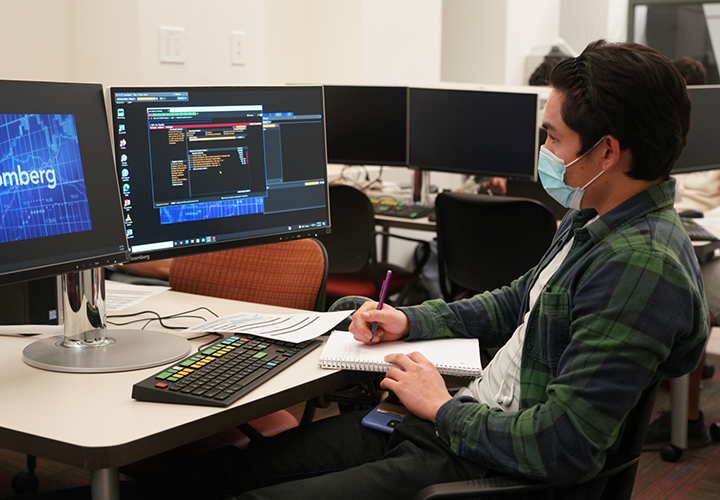
CBA quickly adapted to remote and hybrid learning models during the COVID-19 pandemic. Other noteworthy launches in 2020 included the CBA Advantage program, Financial Literacy Program, Bloomberg Finance Learning Lab, and the “Business for Good” course.
2021
Two more graduate programs launched, including the M.S. in Entrepreneurship and Sustainable Innovation (MSESI) and the Master in Global Entrepreneurial Management (MGEM).
2022: Business Innovation Zone (BIZ) opens
The BIZ brings LMU students from all disciplines together to work on business ideas in a space designed to encourage collaboration, co-creation, and design thinking. The M.S. in Taxation program was also launched this year.
2024
The college introduced a Doctor of Business Administration (DBA), furthering LMU’s status as a leading publicly engaged research institution. A joint program with LMU School of Film and Television, a Master in Entertainment Leadership and Management (MELM), also launched.
2026: LMU College of Business Administration celebrates its centennial year!
For 100 years, LMU College of Business Administration has cultivated bold thinkers, compassionate leaders, and ethical changemakers dedicated to doing business for good. This year, we honor our legacy of impact, innovation, and engagement with a year-long celebration.